NASA Plans To Send AI-Powered Mission To Sample Saturn's Planetary Rings For The First Time
By Global Science JournalThe National Aeronautics and Space Administration (NASA) is planning to work on a new mission concept called PRAXIS (Planetary Rings Autonomous EXploration with In-situ Sampling), which is designed to directly collect and analyse particles from planetary rings for the first time in space exploration. Despite the landmark discoveries made by NASA's Cassini mission, several fundamental questions about how planetary rings form, move and evolve remain unanswered.
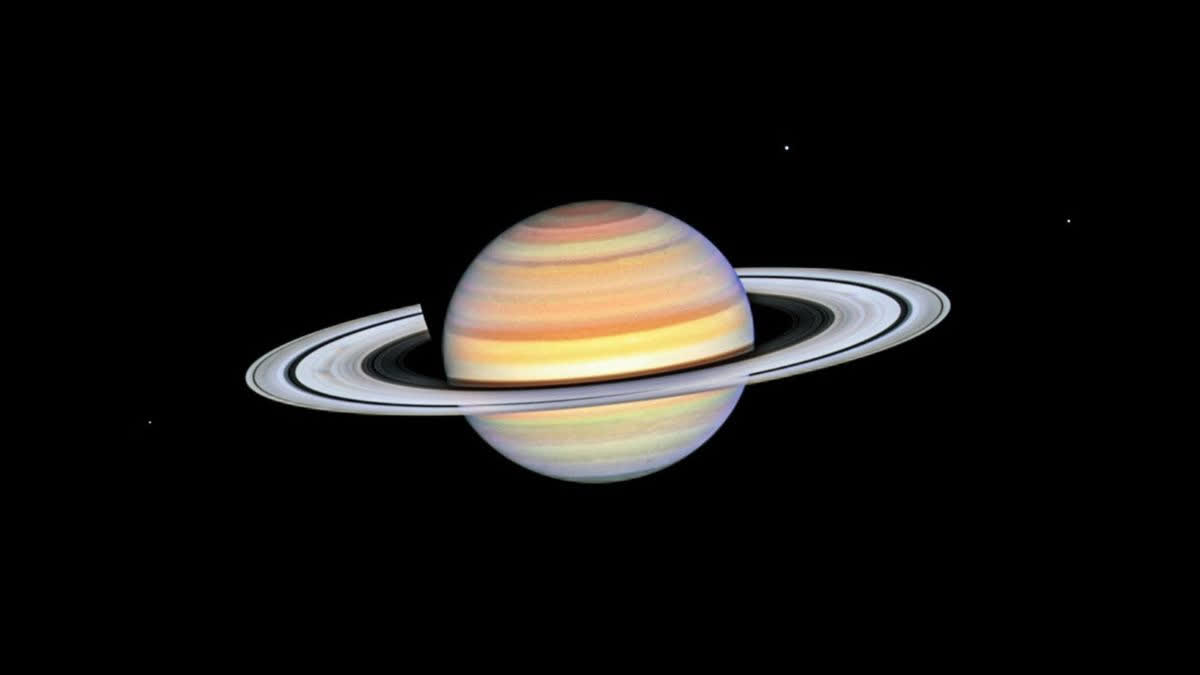
Scientists say the only way to truly understand the microphysical behaviour of Saturn's rings is to sample them directly. Many features within the rings, such as self-gravity wakes, 'propellers', density waves and gap edges, still need to be studied at high resolution.Saturn's rings are made up of particles ranging from tiny, micron-sized grains to boulders the size of houses, mostly made up of water ice that constantly clumps together and breaks apart. PRAXIS aims to deliver the first direct observations of ring particles measuring just millimetres to centimetres in size, a capability that Cassini did not have.
Why autonomy is essential?
As ring particles are always in motion, navigating this environment safely requires advanced robotic autonomy for avoiding collisions, taking precise samples and analysing material in real time. The PRAXIS system borrows ideas from bio-inspired and angling techniques, similar to how a Chameleon catches a fly and how an angler reels in a fish, to catch free-floating particles. The system would also carry miniaturised instruments for immediate analysis.With built-in artificial intelligence (AI), the system would be capable of autonomously collecting ring particles and measuring key scientific properties such as particle size, porosity and composition.
How the mission would work?
The concept builds on groundwork from the earlier Saturn Ring Observer Mission Study, which explored the idea of a spacecraft grazing the rings in orbit and hovering above them to image particles in motion. Under the PRAXIS plan, the spacecraft would first image and study the rings to select a suitable particle, before carrying out a 'touch-and-go' sampling manoeuvre using a long, soft, deployable boom. Because the particles never stop moving, the spacecraft would keep its distance and rely on this extended boom to sample safely without risking collision. Once a sample is collected, the spacecraft would move on to another section, or gap, within the rings to sample a variety of regions.
The feasibility of PRAXIS is set to be demonstrated in Phase I through simulations and system design work, which would make way for a physical prototype to be developed in Phase II. Researchers say the system's flexibility could make it valuable for future planetary formation missions, including potential use in the upcoming Uranus Probe mission.